
Early in my leadership journey, I believed my job was to manage people.
Set goals. Check progress. Correct mistakes. Keep the machine moving.
That approach can create order for a while. It can also create something far less useful: dependence. People begin to look up for answers instead of around for solutions. They wait to be told. They learn how to comply, but not always how to grow.
Over time, I learned something much more powerful. Great leaders do not just manage work. They coach people.
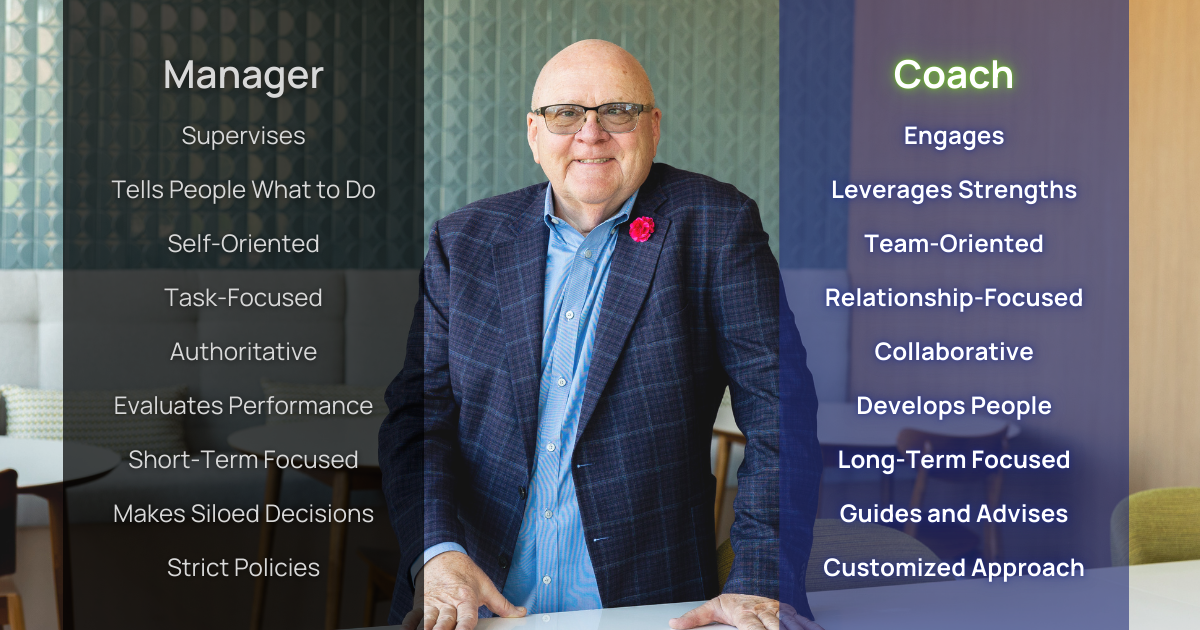
That shift changes everything. A manager focuses on control, oversight, and output. A coach focuses on capability, confidence, and judgment. A manager tries to make sure the work gets done right now. A coach helps people become the kind of thinkers who can get the work done right again tomorrow, and better the day after that.
For me, that is the real difference between management and coaching. One keeps the wheels turning. The other builds people who can drive.
Why Traditional Management Creates Dependency
Management has its place. Businesses need standards, deadlines, and accountability. But many leaders drift into a version of management that quietly weakens the people they lead. They supervise too closely. They answer too quickly. They correct too often. Their good intent becomes a bottleneck.
Harvard Business Review’s work on the leader as coach makes a point I have seen play out over and over again: command-and-control leadership does not hold up well in environments where people need to think, adapt, and solve problems in real time. When leaders believe they must have every answer, they train everyone around them to stop developing their own.
That dependency can look efficient on the surface. The leader is decisive. The team is aligned. The problems get solved. But look closer and you often see a culture where people hesitate before acting, hold back ideas until they feel polished, and default to the leader’s judgment instead of building their own.
That is not a growth culture. That is a permission culture.
Managers often ask, “Did you do what I asked?” Coaches ask, “What are you learning as you do this work?” One question monitors activity. The other develops a human being.
Coaches Develop People, Not Just Performance
The biggest leadership shift I ever made was this: I stopped seeing my role as marking people’s papers, and started seeing my role as helping them get an A.
That is coaching.
A coach still cares deeply about performance. A coach still expects results. A coach still deals with missed commitments and tough conversations. But a coach does something a traditional manager often misses. A coach stays focused on what the person is becoming, not just on what the person produced this week.
Harvard Business Review’s guidance on the questions good coaches ask highlights a truth that every leader would be wise to remember: coaching is driven by inquiry. The coach does not rush to solve. The coach asks questions that help people reflect, clarify, and take ownership.
That is where confidence is built.
When a leader supplies every answer, the team member may leave with a solution. When a leader asks the right questions, the team member leaves with stronger judgment. And judgment compounds. It grows through use. It grows through reflection. It grows through being trusted.
McKinsey’s work on developing leadership capabilities reinforces this idea by emphasizing that lasting leadership cultures are built through role modeling, coaching, and professional growth conversations. That is not decorative leadership. That is how strong organizations reproduce capability.
The Difference Shows Up in the Conversation
If you want to know whether a leader is acting like a manager or a coach, listen to the conversation.
A manager hears that someone missed a target and says, “Why didn’t you hit the number? Next time do it this way.” That may feel efficient. It may even feel decisive. But the learning is thin. The leader has taken the thinking role. The team member has taken the receiving role.
A coach handles the same moment differently.
The coach asks, “What do you think got in the way?”
The coach asks, “What did you learn from this?”
The coach asks, “What would you try differently next time?”
The coach asks, “How can I help you succeed?”
That conversation does not remove accountability. It strengthens it. The person still owns the miss. The person still has to reflect. The person still has to improve. But now the conversation builds capability instead of dependence.
MIT Sloan’s research on how leaders can get the most out of asking questions makes clear that better questions produce better thinking. Leaders who ask thoughtful, open questions create conditions where insight surfaces more readily and people engage more deeply with the problem in front of them.
That is coaching in action. Not soft. Not vague. Not indulgent. Practical, disciplined, and developmental.
Coaching Turns Mistakes Into Learning Moments
Another major difference between a manager and a coach shows up when something goes wrong.
Managers often correct mistakes. Coaches create learning moments.
That language matters to me. I have long believed that if people act in good faith and something does not work, the smartest response is not punishment. It is learning. When people feel fear, they hide mistakes. When people feel safe, they share what happened and the whole tribe gets wiser.
McKinsey’s research on new leadership for thriving organizations points to listening, inspiring, and caring as central leadership behaviors in stronger organizations. Those behaviors are not side notes. They create the conditions where learning can happen without shame.
Coaching cultures do not lower standards. They make learning faster. People become more willing to tell the truth early, ask for help sooner, and reflect on what needs to improve. That is how good judgment develops. That is how trust grows.
Deloitte’s research on employee engagement and leadership development underscores the importance of giving leaders the coaching they need if organizations want a more engaged workforce. Engagement rises when leaders build people, not just monitor them.
Why Coaching Leaders Build Stronger Organizations
Here is the practical payoff: coaching leaders build stronger organizations because they build stronger people.
They create teams that do not freeze when the boss is not in the room. They create cultures where people think, speak up, solve problems, and take ownership. They create future leaders instead of permanent followers.
That matters because growth does not come from one heroic leader at the top. It comes from many people throughout the organization developing the confidence and judgment to lead where they are.
McKinsey’s perspective on 21st-century leadership emphasizes that organizations need leadership factories, not isolated stars. I could not agree more. And one of the fastest ways to build that kind of environment is to make coaching a daily leadership discipline.
That discipline can start with a few simple shifts:
- Ask more questions before giving advice.
- Focus on what the person is learning, not just what went wrong.
- Use mistakes to build wisdom instead of fear.
- Measure leadership success by how many people are growing around you.
The difference between a manager and a coach is not semantic. It is cultural. It shapes how people think, how they respond to mistakes, how they solve problems, and whether they grow.
Managers focus on getting the work done.
Coaches focus on helping people grow.
And when people grow, the work gets done better than any manager could control.
READY TO GET STARTED?
Get in touch
I’d love to help you build a culture where people feel connected, do meaningful work, and bring out the best in each other. Whether you’re looking for a keynote that sparks change or one-on-one coaching, let’s talk about what’s best to build your tribe.